Work is labeled by actual scope and status. Educational investigations are not represented as customer engagements, and recommendations are not represented as completed controls.
01 / Infrastructure implementation · November 2026
Multi-domain cloud release assurance
Objective: publish independently branded sites from one codebase without losing domain-specific routes or mixing deployment credentials.
Implementation: Vite build, isolated static bundles, GitHub Actions deployment matrix and per-target secret references. Existing forms were preserved while cybersecurity pages were introduced.
Measured configuration: six production deployment targets, three configured security-header directives and eight required HTML paths checked by the build.
Public verification, 24 Nov 2026: four of five tested paths returned their expected page identities (homepage, cyber contact, Snap Forms, fill tool). The portfolio path returned the homepage. This discrepancy was recorded; repository changes generate and validate the intended page.
Limitations: site implementation and testing were AI-assisted; this is an organizational project, not an independently verified personal employment achievement. No penetration test, live header enforcement or successful form submission is claimed.
02 / Educational SOC investigation · 17–19 Nov 2026
Network reconnaissance and detection quality
Objective: distinguish observed scanning from a confirmed compromise.
Observed telemetry: a Zeek notice reported at least 25 hosts, 14 destination ports, 83 minutes and 22 seconds of activity and a normalized risk score of 80 (not a probability of compromise).
Analysis: separately reviewed Emerging Threats Suricata SID 2009359, revision 6, an HTTP Nmap NSE user-agent indicator. Its firing was not established for the Zeek notice.
Deliverable: retain the informational indicator and propose separate multi-port correlation with approved-scanner exclusions and false-positive validation.
Outcome: documented investigation and proposed detection changes; no production deployment, measured false-positive reduction or confirmed intrusion is claimed. Network identifiers and customer details are omitted.
03 / Collaborative threat-hunting case review · November 2026
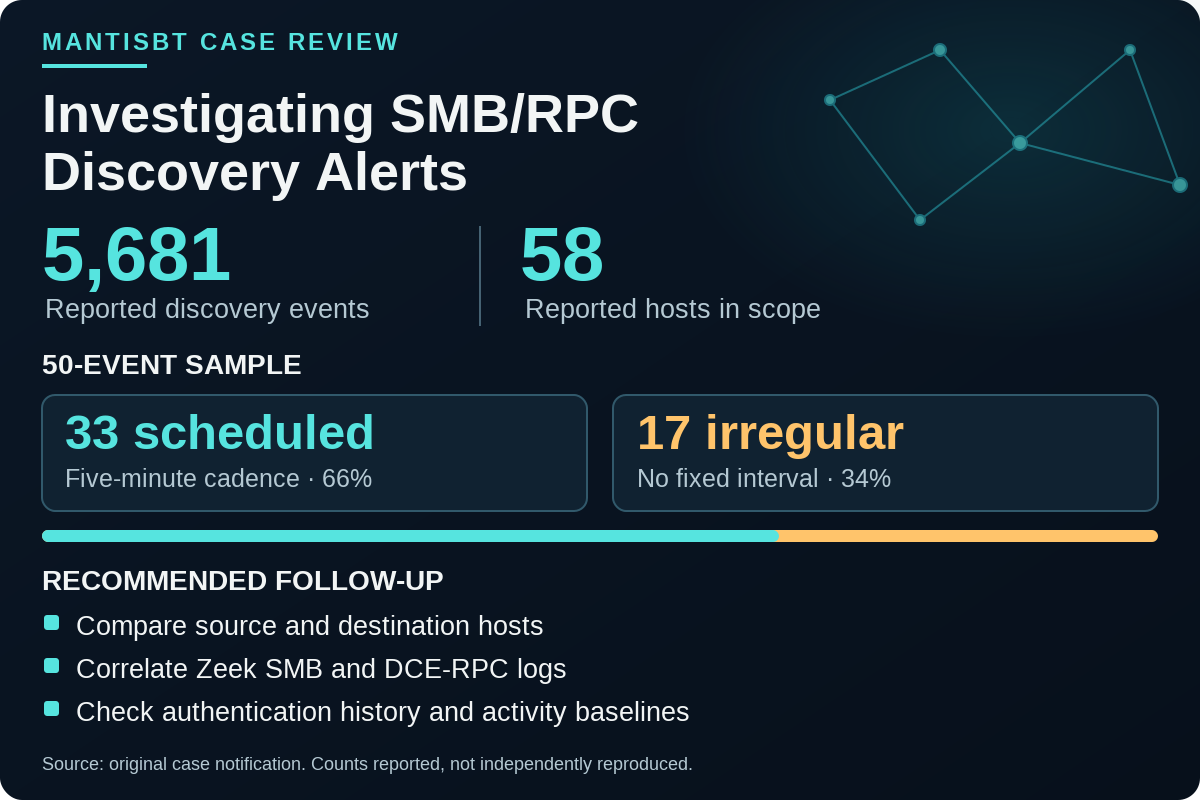
Mantis case management: SMB/RPC discovery investigation
Sanitized case visualization. Scope and sample counts were reported by the originating analyst; they were not independently reproduced.
Objective: evaluate whether recurring Windows network enumeration alerts indicate authorized administrative activity or potentially unauthorized reconnaissance.
Tools and framework: MantisBT for case documentation and analyst handoff; Zeek/BZAR network discovery notices; Malcolm/OpenSearch for telemetry investigation; MITRE ATT&CK Discovery as the behavioral classification.
Reported sample: the originating analyst reported a total scope of 5,681 events across 58 hosts (whether these were unique sources, destinations, or both was not established). The analyst documented a sample of 50 alert events. Of these, 33 (66%) followed a recurring schedule and 17 (34%) were irregular. These are observations reported in the original case, not independently reproduced measurements or a detection-accuracy score.
Collaborative review: the follow-up note recommended analyzing scheduled and irregular events separately, validating asset and account context, correlating SMB and DCE-RPC records with the corresponding notices, establishing a historical baseline, and examining related authentication and endpoint indicators.
Risk-based decision: periodic behavior alone does not establish legitimacy, and irregular behavior alone does not establish malicious intent. Validate the responsible systems, authorized services and protocol operations before suppressing alerts or declaring an incident.
Case-management outcome: a documented investigation recommendation was added to the Mantis record. A manager subsequently indicated intent to close the ticket because of age and lack of further updates from the originating reporter. No confirmed compromise, verified benign explanation, completed remediation or implemented alert suppression was established in the supplied record.
Evidence and attribution: sanitized summary of a collaborative educational SOC case notification. Original findings belong to the originating analyst; the follow-up is a separate contributor's review. Individual authorship by the portfolio owner has not been established. Internal links, organization and sensor names, account identifiers and network details are withheld.
Competencies: threat hunting, evidence evaluation, protocol analysis planning, false-positive management, written analyst communication and case lifecycle governance.
04 / Educational SOC case review · November 2026
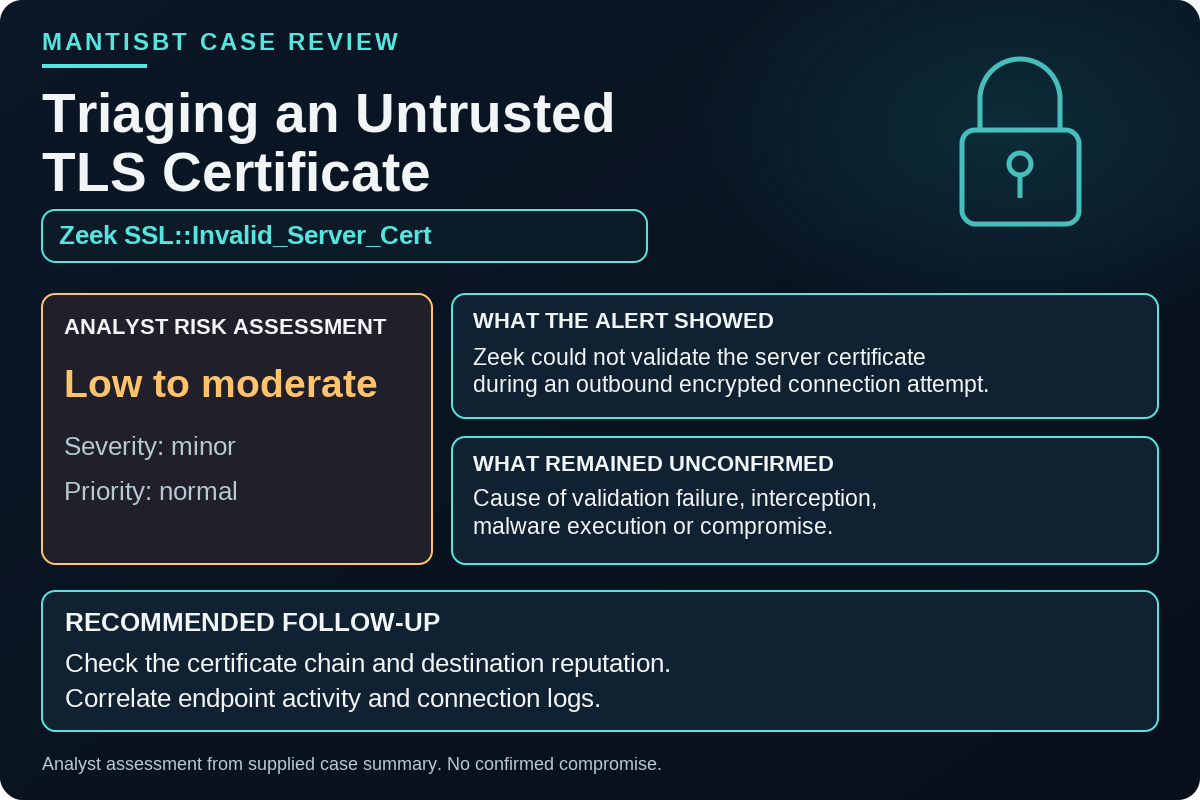
Mantis case management: untrusted TLS certificate and timestamp reconciliation
Objective: reconcile case timestamps, assess the meaning of a Zeek certificate-validation notice, and determine what evidence is needed before escalating or closing the investigation.
Reported analyst assessment and recommended follow-up, not a confirmed incident.Conditional time-zone reconciliation; the original ticket time zone remains unverified.
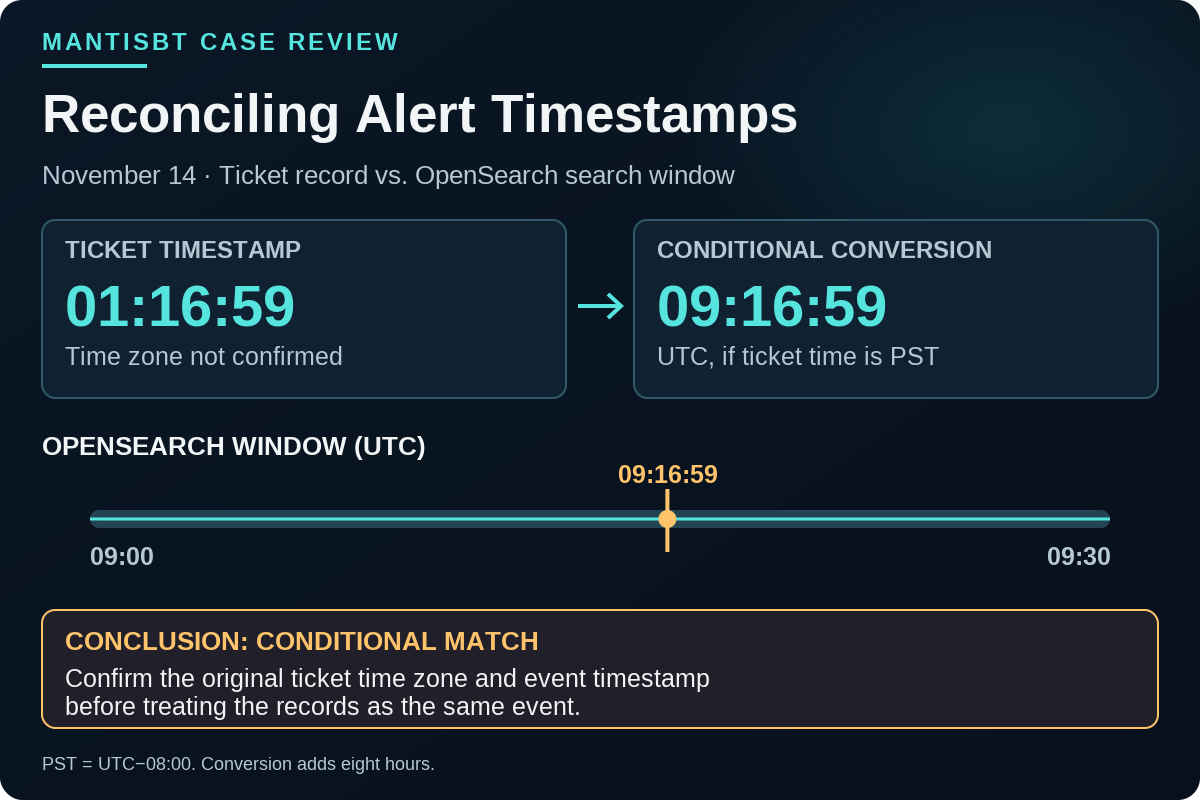
Timestamp reconciliation: the case listed November 14 at 01:16:59, while the OpenSearch dashboard specified 09:00–09:30 UTC. If the case timestamp was Pacific Standard Time (UTC−08:00), the event converts to 09:16:59 UTC, within the search window. Verify the ticket time-zone settings and original event timestamp before asserting that the records refer to the same event.
Observed alert: according to the supplied case summary, Zeek raised SSL::Invalid_Server_Cert during an outbound encrypted connection attempt because the server certificate could not be validated against available trusted certificate authorities. The alert does not by itself establish that encrypted communication succeeded.
Analyst risk assessment: low to moderate; ticket severity minor, priority normal. No direct evidence of malware execution, credential theft, data exfiltration or successful command-and-control communication was established in the supplied summary. A legitimate application or certificate configuration issue is plausible, not verified.
Alternative hypothesis: the practitioner reports that the destination was identified in a malicious-IP reputation source. This reputation finding was not independently verified for this publication; it is contextual evidence, not proof of interception. Man-in-the-middle activity and compromise remain unconfirmed.
Recommended follow-up: review certificate chain, issuer, validity dates and destination reputation; correlate Zeek connection and TLS logs with endpoint process and authentication telemetry; confirm timestamp settings and assess whether the application and destination were authorized. Escalate if corroborating indicators warrant it.
Evidence and limitations: sanitized practitioner-provided analysis; raw telemetry and independent validation are not available here. No mitigation, confirmed root cause or closure outcome is claimed. Internal hosts, IP addresses and ticket links are omitted.
Objective: trace how network telemetry becomes searchable evidence and analyst cases.
Architecture: sensors feed parallel Suricata and Zeek analysis; Logstash processes records, OpenSearch provides search, Arkime supports packet/session investigation and Mantis supports manual case tracking.
Documented output: two network monitoring diagrams describing sensor, analysis, ingestion, storage, analyst access and case-management components.
Engineering focus: evidence provenance, trust boundaries and automated versus analyst decisions.
Limitations: educational architecture documentation, not production ownership or a verified throughput, detection-rate or uptime measurement.
06 / Professional background · practitioner-reported
Security governance and enterprise systems
Scope: professional résumé describes HIPAA security assessments and CMMC Level 2 preparation, including risk classification, control mapping, evidence collection, role-based access, audit logging, backup and recovery, and remediation planning.
Technical context: Microsoft cloud and identity, enterprise systems integration, access governance and operational documentation.
Evidence status: practitioner-reported experience. Customer records, control counts and assessment outcomes are not published. Preparation does not imply certification or a finding of HIPAA compliance.
Project evidence standard
What a completed engagement should demonstrate.
Publish only authorized, sanitized evidence and distinguish baseline measurements from post-remediation results.
01
Scope and ownership
Dates, authorized assets, technical responsibilities, team roles and constraints.